Selected Work / The Last Hour
The Last Hour
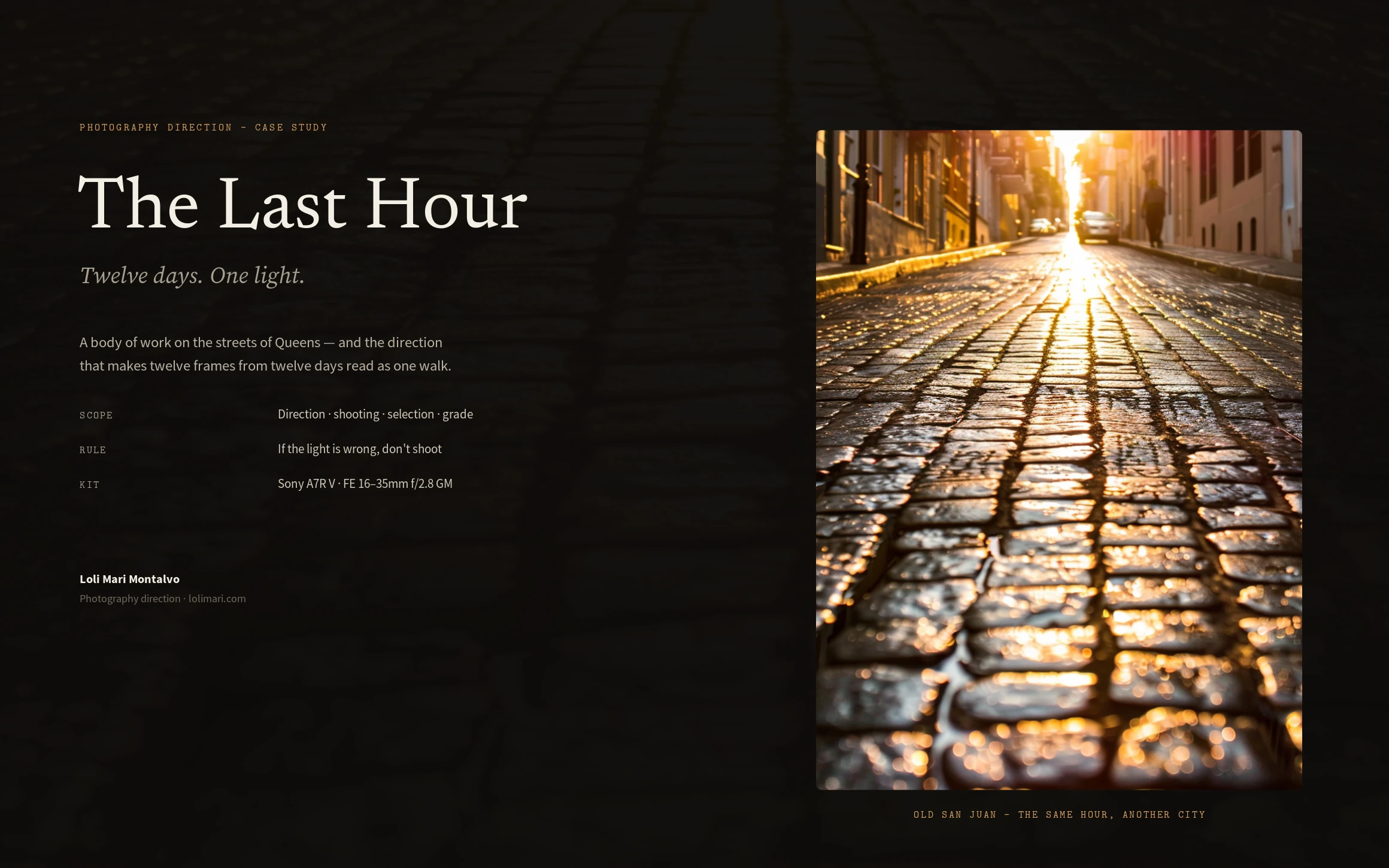
A body of work on the streets of Queens — and the direction that makes twelve frames from twelve days read as one walk.
Personal body of work · Queens, NY · Photography direction · 2026
Role
Photography Direction
Scope
Direction, shooting, selection, grade
Outcome
A direction that survives a change of subject
Overview
This is my own photography — a body of work made on the streets of Queens, shot on a Sony A7R V with a 16–35mm GM. It is here as a case study in photography direction rather than as a gallery: what matters is not the individual frames but the rules that hold them together.
The challenge
A photograph is easy. A body of work is hard, because it has to cohere across days, blocks, seasons and weather — and most photographers try to solve that in the edit. By then it's too late. Coherence has to be decided before the shutter, or you are just sorting through luck.
My strategic thinking
I direct my own work the way I'd direct someone else's: by deciding in advance what I will not photograph. A body of work is a set of refusals. Three of them do all the work here — one on light, one on subject, one on people — and everything that survives them belongs to the series automatically.
Process
Rule one: shoot the last hour, or don't shoot. One narrow window of low sun, and if the light is wrong the day is cancelled. Rule two: every frame needs something growing — botanical against built. Rule three: no protagonists; people pass through, they don't pose. Then the edit: four selects from twelve, killing anything that only works because it is pretty.
The technical spine
Sony A7R V, FE 16–35mm f/2.8 GM, f/5.6, base ISO 100, uncropped 61 MP RAW. Wide, stopped down, at base ISO — none of that is a look, it's a discipline that keeps the frames comparable. The constraint is what does the work: twelve frames made on twelve different days share a single quality of light, so the contact sheet reads as one afternoon.
The final solution
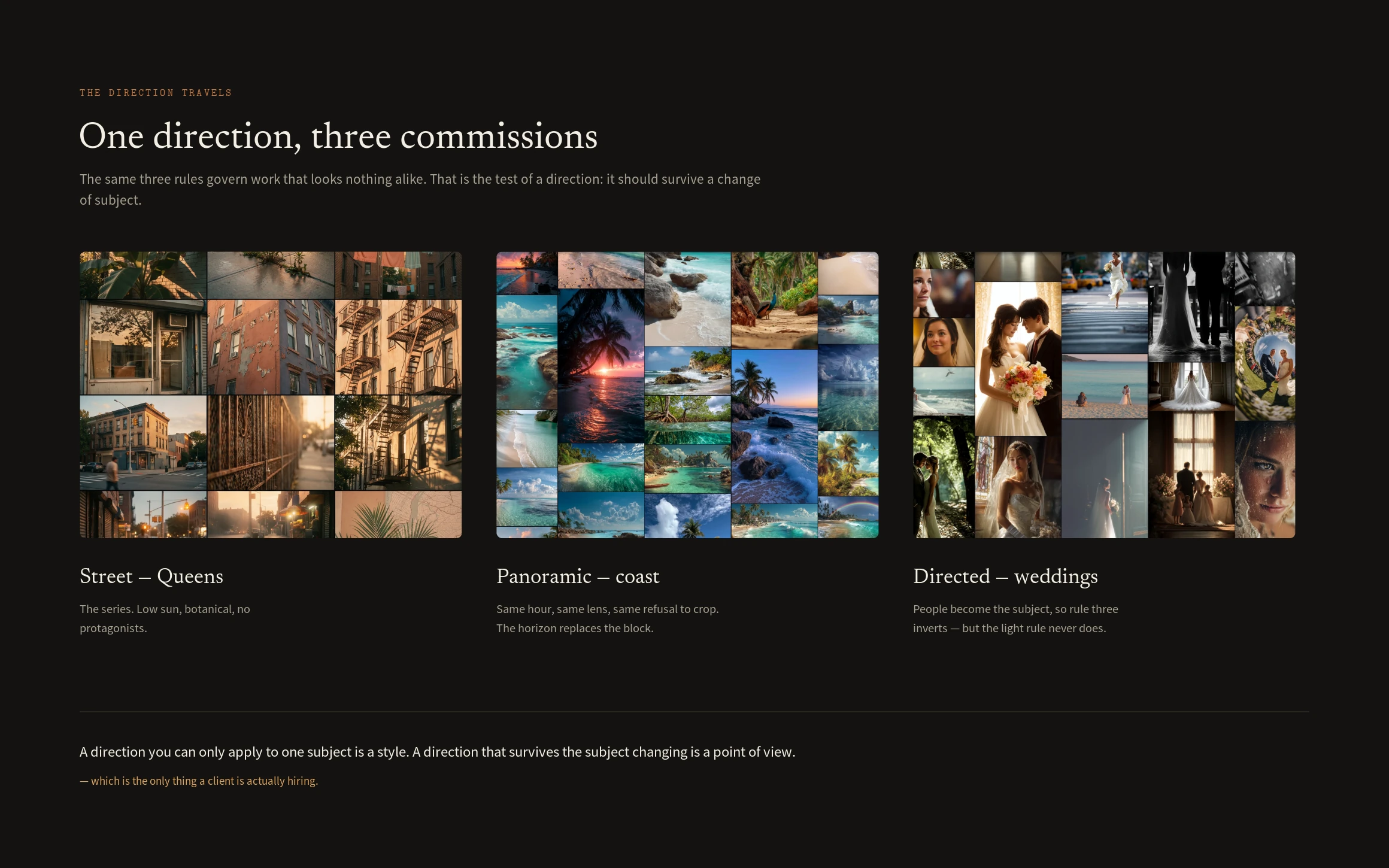
A contact sheet that coheres, and a direction that then travels. The same three rules govern work that looks nothing alike: the Queens street series, coastal panoramic work, and directed wedding commissions. On the weddings, rule three inverts — people become the subject — but the light rule never does.
Results
The series holds. More usefully, the direction is portable: it survives a change of subject, a change of client and a change of city — the same hour of light carries an Old San Juan street as readily as a Queens block.
Lessons learned
A direction you can only apply to one subject is a style. A direction that survives the subject changing is a point of view — and a point of view is the only thing a client is actually hiring. The edit is where authorship happens: four is a series, twelve is a folder.
Next case study
Web to Print →