Selected Work / The Artwork Is the Footage
The Artwork Is the Footage
Ten short films built entirely from my own paintings — cause work, product campaigns, a band promo, and the hand on the paper.
Personal practice · fineartsloli · Viva Nativa · Video production · 2026
Role
Video Production & Motion
Scope
Concept, animation, edit, sound, cutdowns
Outcome
No shoot, no stock — and it stops the scroll
Overview
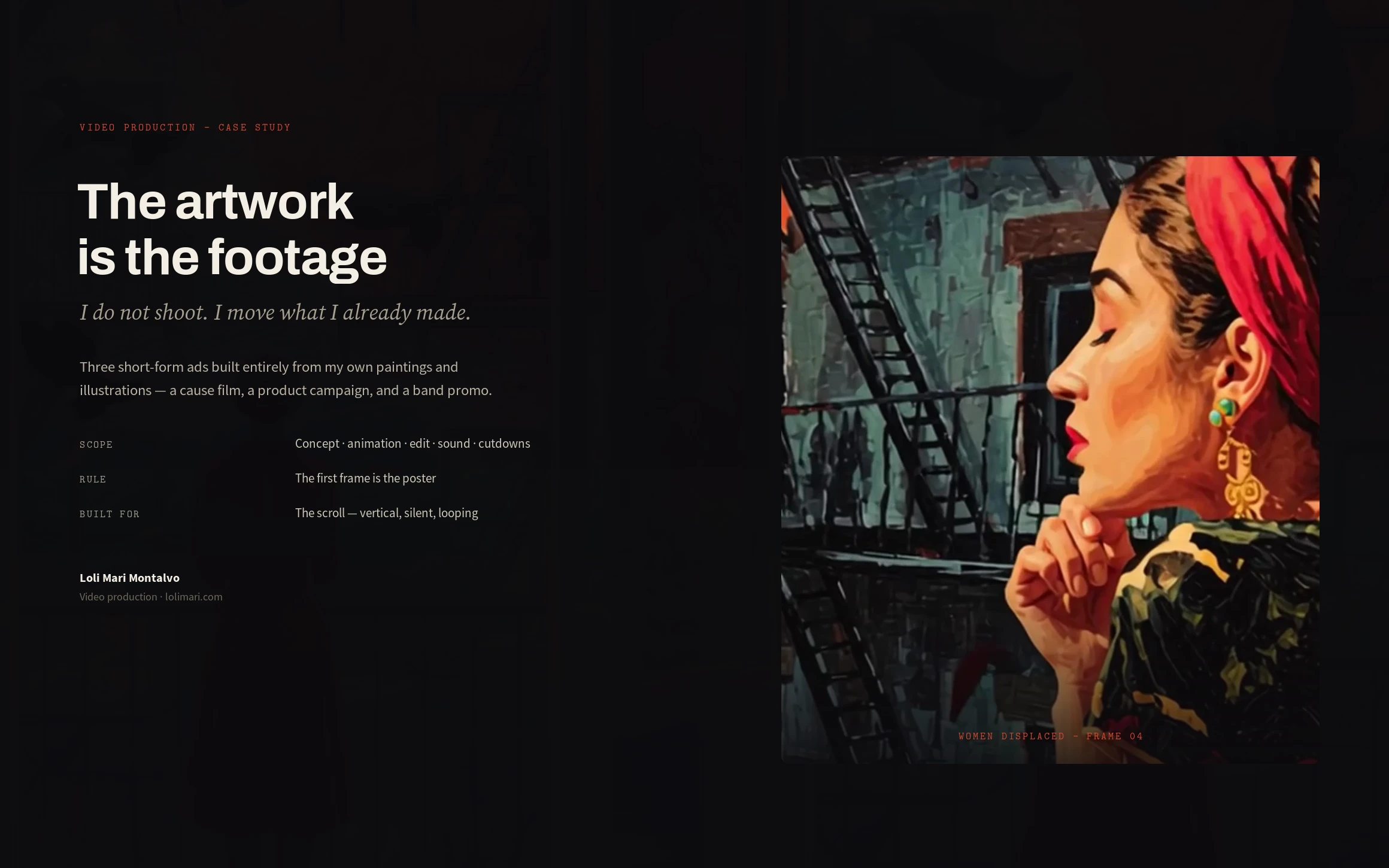
Ten short films, all of them mine: a cause film on displacement, product campaigns for wall art, apparel, framed prints and paintings on the wall, a promo for Viva Nativa, and four process reels that put the camera straight on the paper. Every frame in all ten is a painting or an illustration I made by hand — there is no footage, no stock and no camera anywhere in this case study.
The challenge
Short-form video is where an audience actually is, and it is the one format most artists never make — because shooting is expensive, slow, and produces something that doesn't look like their work. I wanted video that was unmistakably mine, that cost nothing to originate, and that could be made as fast as I paint.
My strategic thinking
I stopped thinking of video as something you shoot and started treating it as something you move. The artwork is the footage. Every film begins from paintings I already have, which means frame one is not an establishing shot — it is a finished picture. In a feed, where the film is competing with a thumb, that is the whole advantage: the work stops the scroll before the motion has even started.
Process
Three rules govern all of it. The first frame is the poster — no build-up, no lead-in. It has to work with the sound off, because most people never hear it, so the image and the type carry the argument and sound is a reward rather than a requirement. And it has to loop: a film that ends where it began gets watched twice, so the last frame is cut to hand back to the first.
The films
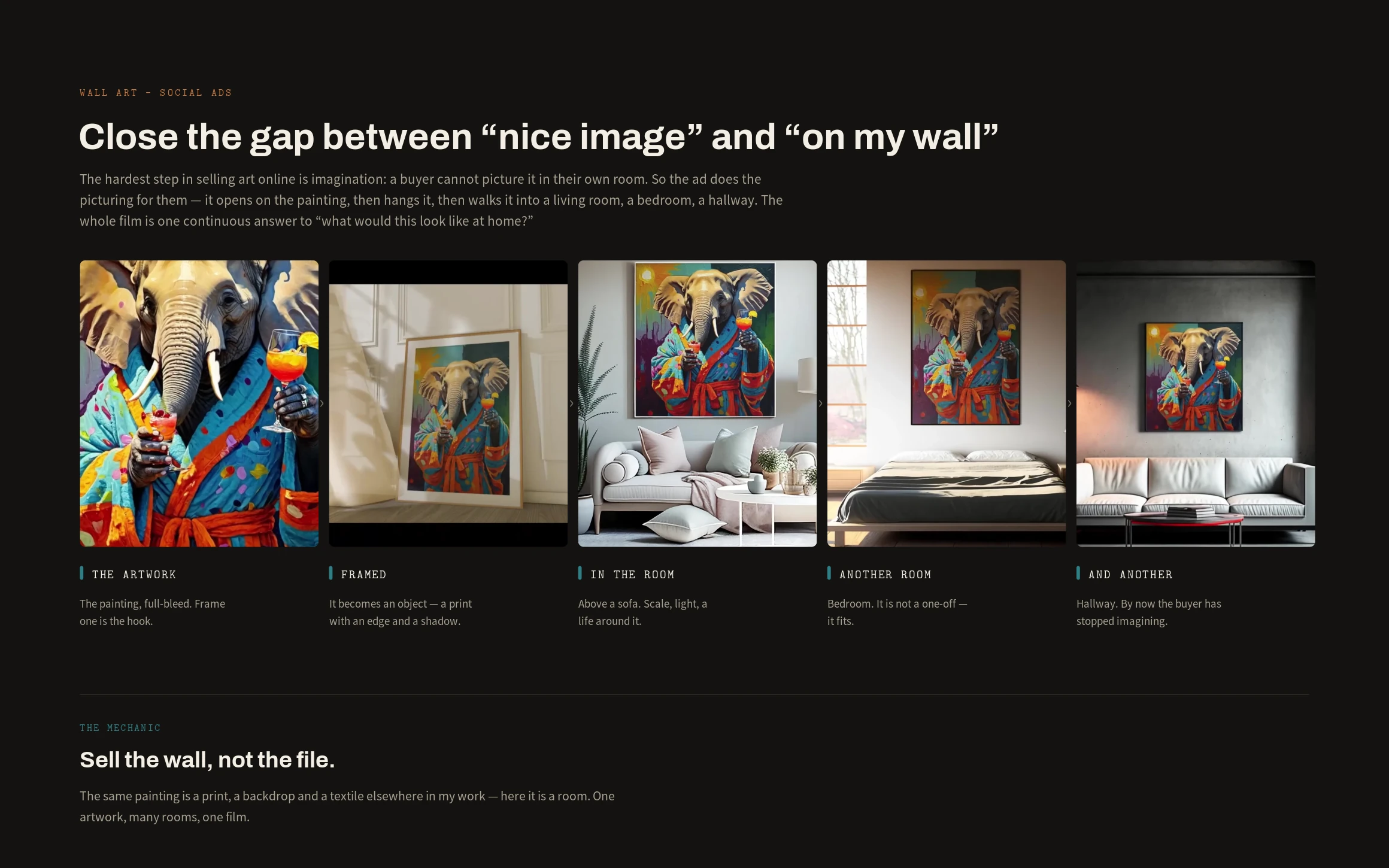
Women Displaced is a 16:9 cause film cut from a body of collage paintings — women at windows, birds leaving, the fire escape as a border. It drifts rather than cuts, because it is not a story about displacement so much as the feeling of it. The wall-art campaign does the opposite job: it sells. The hardest step in selling art online is imagination — a buyer cannot picture the piece in their own room — so the film does the picturing for them, opening on the painting, framing it, then hanging it above a sofa, in a bedroom, along a hallway. Sell the wall, not the file. The Kiss does the same job for the originals: one wall, one light, and the paintings changing inside the frame, so the buyer sees the room before they see the picture. And El Gallo, a 9:16 promo for Viva Nativa, is built around the rooster: the bird that announces the morning whether or not you asked it to, which is a fair mascot for a band that has never been quiet. The rest of the library keeps going back to work: the artwork becomes apparel for Afrolatin Rockstar, framed editions for the Quixotes prints, and a tarot deck. And one film goes the other way entirely — the Afrolatin Tarot reel runs the finished plate backwards, to the paint, and then to the pencil line underneath. It sells nothing and does the most work: anyone can post a finished picture, but showing the sketch is what tells a buyer a human made it. Three more go further and simply film the hand — graphite going down on paper for Bangkok Market and Cherry Ants, oil going onto canvas for Slaveship Regret. The product films ask for a sale; these ask for nothing, and they are the reason the sale is believed. In a feed where nobody knows who made the image, the hand is the only credential that cannot be faked.
The final solution
One cut, framed three ways — 9:16 for reels, 1:1 for feed, 16:9 for site and YouTube — with the composition protected so nothing important ever sits where a caption, a username or a thumb is about to land. Under thirty seconds, always.
Results
Video became something I can originate in a day rather than commission in a month, and it looks like nothing else in the feed because it is made of paintings nobody else has. The same artwork is already a print, a backdrop and a textile elsewhere in my work — video is simply one more room it can walk into.
Lessons learned
None of the constraints here are style — they are what a feed physically does to a film. Silence, a thumb, and a scroll are the real brief. Design for those and the work gets seen; ignore them and it doesn't matter how good the footage was.
Next case study
Unfinished Fables →