Selected Work / Relay
Relay
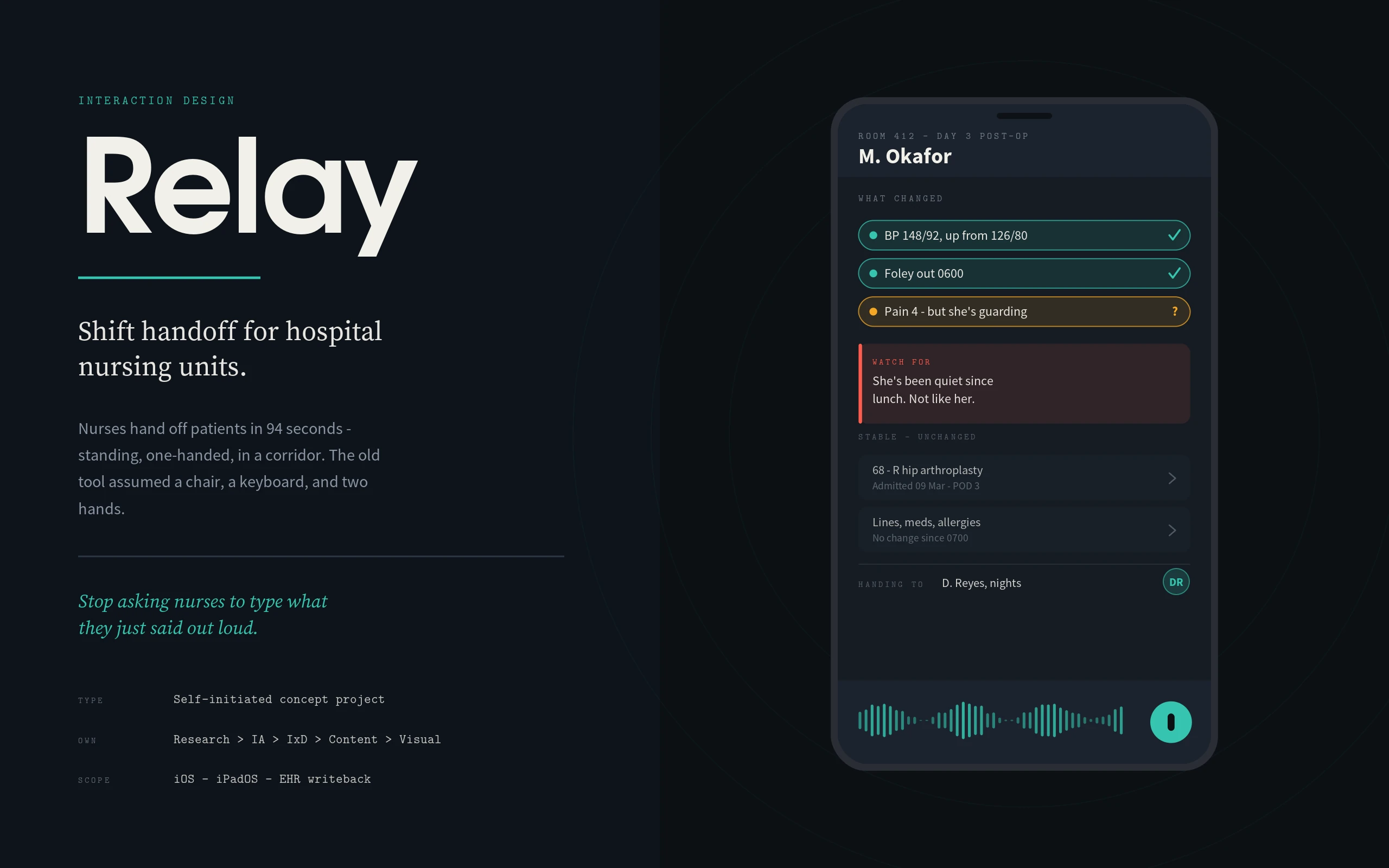
Shift handoff for hospital nursing units — a product that listens to the handoff already happening instead of asking for it a second time.
Relay, a clinical handoff tool (self-initiated concept) · Interaction design · 2026
Role
Product Design — research, IA, interaction, content, visual
Scope
Research, IA, interaction, content, visual
Outcome
The interaction model is the product
Overview
Relay is a shift-handoff product for hospital nursing units — a self-initiated concept, designed end to end. Every twelve hours a nurse passes responsibility for six to eight patients to the nurse arriving. That transfer is the most fragile moment in a patient's stay: what the outgoing nurse knows and doesn't say becomes information the incoming nurse doesn't have. I ran the research, set the information architecture, designed the interactions, wrote the words, and drew the interface.
The challenge
The unit already had software for this. Nobody used it. They used paper — folded into a scrub pocket, annotated in three colours of pen, thrown away at the end of the shift. The digital tool opened once per shift, at the very end, when someone remembered they were supposed to fill it in and typed a sentence that satisfied the audit and helped no one. The brief said improve the handoff form. That brief was the problem.
Research
I shadowed fourteen handoffs across three units on day and night shifts and timed every one. Eleven contextual interviews, from six months' experience to twenty-two years. Forty discarded paper sheets, collected with permission and coded against what the digital form asked for. Median handoff: 94 seconds per patient, standing up, in a corridor, one hand full. Nine pieces of information appeared on more than 80% of the paper sheets — and four of them had no field in the software at all. The most common annotation was not a clinical value. It was a concern: watch her, she's been quiet. The software had no place to put a hunch, so the hunch didn't travel.
My strategic thinking
Every nurse said a version of the same sentence: I already said all of this out loud to the person standing in front of me, and now I have to type it again for the computer. That is the whole case. The handoff already happens — the software wasn't capturing it, it was asking for it a second time. A form makes you translate what you know into its categories, one field at a time, and that translation is the work nurses were refusing at hour twelve. So: stop designing a form. Design the conversation, and let the record fall out of it.
The interaction model
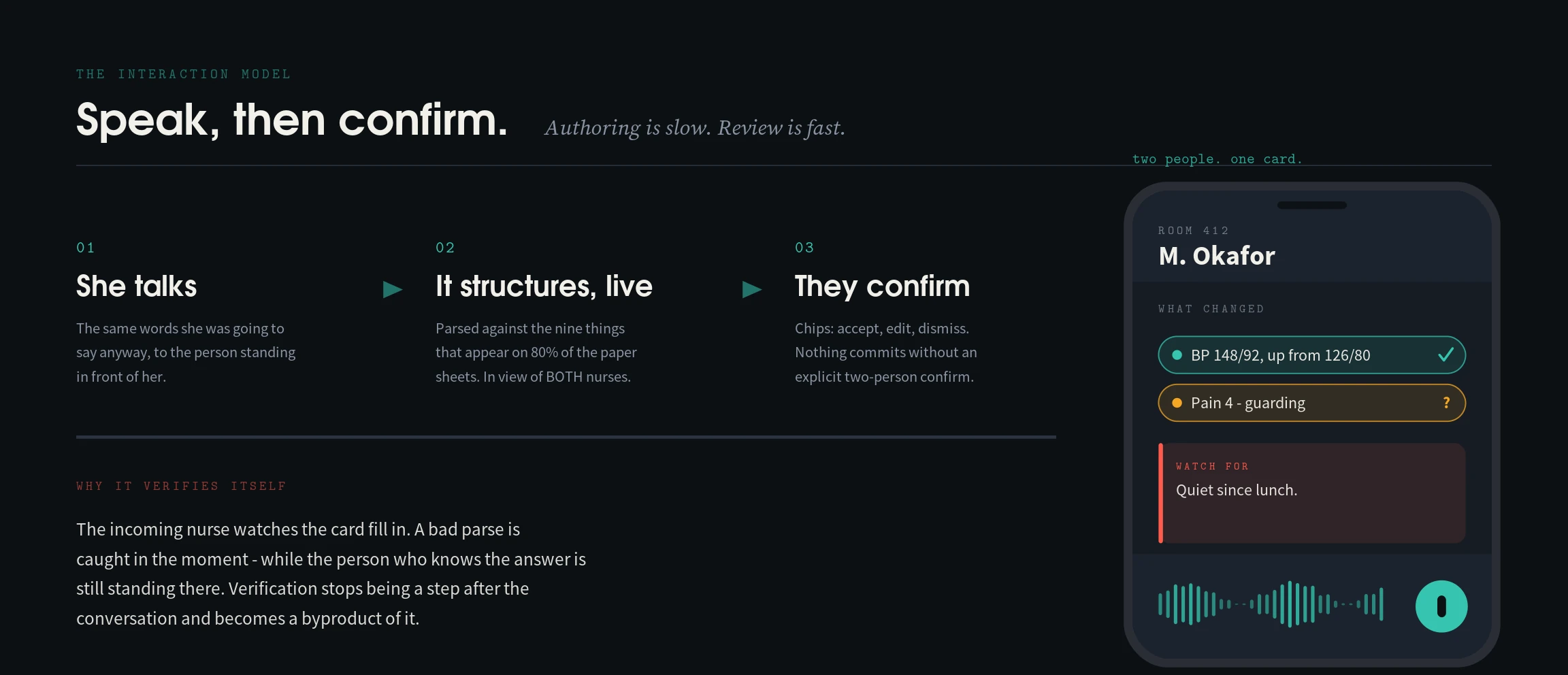
Speak, then confirm. The outgoing nurse taps once and talks — the same words she was going to say anyway. Relay transcribes on device, parses against the nine high-frequency structures, and populates the patient card live, in view of both nurses. That last part is the move: the incoming nurse watches the card fill in, so a bad parse is caught in the moment, while the person who knows the answer is still standing there. Verification stops being a step after the conversation and becomes a byproduct of it. Authoring is slow; review is fast.
Decisions & the system
One-handed by default — every primary action in the bottom third, because the other hand is always busy. Confirm, don't compose: parsed fields render as chips you accept, edit or dismiss. The concern is a press-and-hold, not a field, because hunches arrive mid-sentence and any interaction that requires leaving the current context loses them. Nothing auto-saves silently; the handoff commits only on an explicit two-person confirm — the one place friction is correct. Type is scaled from the observed corridor viewing distance, and the card is built to be read by someone standing beside you, at an angle. Colour carries exactly one job: state. Confirmed, unconfirmed, flagged. In a room already screaming in red and amber, a fourth voice is noise.
The tradeoff I want to be honest about
Voice-first capture in a clinical setting is a real risk, and I underweighted it at first. Early builds parsed accented English measurably worse — which in a nursing workforce is not an edge case but a large share of the users, and a fairness problem rather than a bug. We held ship, expanded the evaluation set, and — the part that mattered more — made the typed path fully equal rather than a degraded fallback, so a bad parse costs a nurse a few seconds and never her credibility or her patient's record. If the typed path had stayed second-class, Relay would have quietly worked better for some nurses than others, and the average would have looked fine. Averages hide exactly this.
What I'd measure
This is a concept project, so I won't invent results. The metric that would falsify the thesis is concerns recorded per handoff: the whole argument is that the hunch is the most valuable thing in a handoff and the old tool had nowhere to put it. Next, adoption shape rather than adoption count — opened during the handoff means a working tool; opened after means I built a nicer audit ritual. Duration, read carefully in both directions, because a good handoff might get slightly longer as things that used to go unsaid start being said. Parse accuracy segmented by accent and first language, reported separately with a floor rather than a mean. Correction rate on parsed chips, as the health check for confirm-don't-compose. And, weighted equally: whether nurses agree the record reflects what they actually said.
Lessons learned
I designed for the outgoing nurse for too long. The first stretch of work optimised the capture — making it fast and cheap to give a handoff — but the value of a handoff accrues entirely to the person receiving it, and I didn't seriously design that until a nurse said, flatly, this is great for the person leaving. The unit board and the stable-versus-delta split both came out of that correction, and both should have been in the first sketch. And I would test the parse across accents on day one, not late. I found a fairness problem because we went looking; if we hadn't, we'd have shipped a tool that worked better for some nurses than others and called it a success.
Next case study
Marea →