Selected Work / Fondo
Fondo
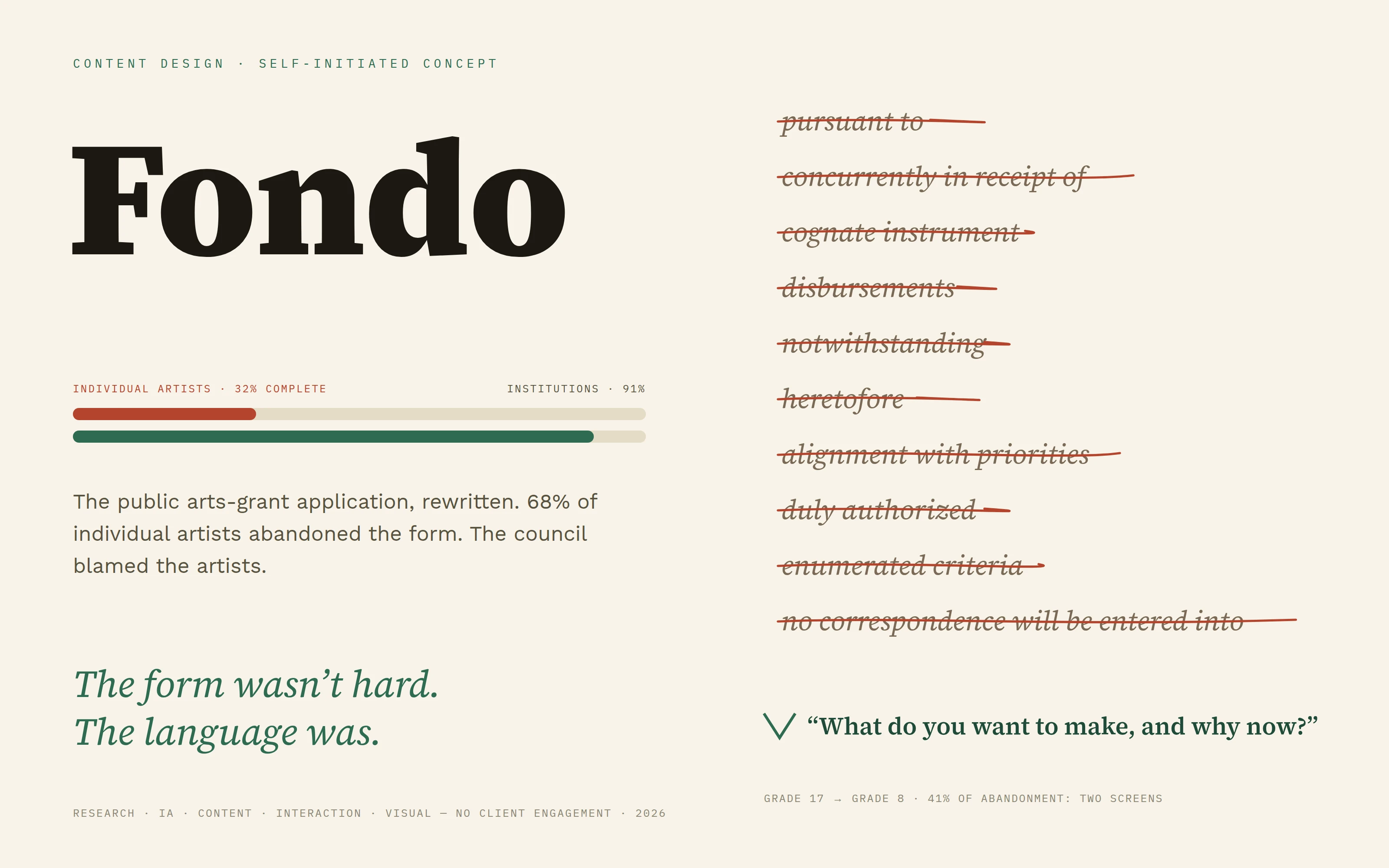
The public arts-grant application, rewritten — where 68% of artists abandoned the form, and the wall was made of language.
Fondo, a state arts council (self-initiated concept) · Content design · 2026
Role
Product Design — research, IA, content, interaction, visual
Scope
Research, IA, content, interaction, visual
Outcome
The form wasn't hard. The language was.
The wall was made of language
Anatomy of one sentence
Where they gave up
The rewrite, side by side
Grade 8, or it doesn’t ship
Overview
Fondo is a self-initiated concept: the public arts-grant application, rewritten. A state arts council gives away money, and individual artists — the people the fund exists for — were the least likely group to successfully ask for it. I ran the research, restructured the application, rewrote every word of it, designed the flow, and drew the interface.
The challenge
68% of individual applicants who started an application never submitted one. Institutions — museums, theatres, nonprofits with grant-writing staff — completed at 91%. The council read that gap as a capacity problem, and proposed workshops teaching artists how to fill in the form. I want to be precise about why that's the wrong fix, because it is the whole case: when 68% of your users fail, that is not 68% of your users being deficient. That is a design defect with a very large sample size.
Research
Seventeen moderated sessions with artists who had abandoned an application, using their own half-finished drafts. A field-level analytics teardown, not page-level. All forty-four pages of the application read and run through readability analysis. Four panel reviewers — the people who actually read the submissions — interviewed about what they needed and what they ignored. And the legal reviewer, interviewed early, on purpose, rather than discovered at the end. The abandonment turned out to be concentrated, not diffuse: 41% of it happened on two screens. Mean readability was grade 17 — postgraduate. And 61% of individual applicants started on a phone, on a form built for a desktop.
My strategic thinking
The eligibility page contained the sentence: applicants must not be concurrently in receipt of disbursements from a cognate instrument. Not one of the seventeen artists could tell me what it meant. Four assumed it disqualified them and closed the tab. It did not disqualify them — it means you can't get two grants for the same project. The form was rejecting eligible people using nothing but a sentence. The form isn't hard. The language is. Every abandoned application was a sentence the council could have written differently. Content design wasn't a polish layer here; it was the diagnosis, the intervention, and the measurement.
The rewrite
Grade 8 reading level or it doesn't ship — measured on every screen, in CI, as a build check rather than a guideline. Second person, active voice. No word survives that an applicant wouldn't say. Every question states what it's for. The eligibility clause became: are you already getting money from another Council grant for this same project? If so, you can't apply here — but you can apply for a different project. Same rule, same legal effect; one of them turns eligible artists away. The field called Statement of Artistic Intent and Alignment with Council Priorities — a blank box with no question in it — became: what do you want to make, and why now? I got the replacement copy by transcribing what the panel reviewers said when I asked them, in a room, what they hoped to read. It took one afternoon. The question had been failing artists for eleven years.
Structure, errors & interface
Content-led IA: eligibility became a check, not a wall — four plain questions answered in thirty seconds, before you invest anything, with no account required to find out whether you're wanted. Then ordered by the applicant's mental model rather than the council's filing system: who you are, what you want to make, what it costs, what you've done before. The forty-four-page guidelines PDF was deleted and everything load-bearing inside it moved to the point of need. Every error message rewritten to say what happened, why, and what to do next — never to blame. Invalid input in field 7 became: that budget doesn't add up to your total, check line 3. And the interface is deliberately restrained: this is a public service, used under stress, on an old phone in bad light. WCAG 2.2 AA throughout, because a public fund is obliged to be usable by the public.
The legal negotiation
Plain language usually dies in legal review, so I didn't take the rewrite to legal at the end. I brought the legal reviewer into the research — she watched two sessions and saw an artist misread the eligibility clause and close the tab. After that she was the rewrite's strongest advocate, and she reframed her own constraint for me: legal doesn't need archaic words, it needs unambiguous ones. Plain language, done properly, is more precise than legalese — it just doesn't sound defensive. We kept the exact legal terms in a linked appendix for the four places they were genuinely required, and nowhere else. Legal is not the obstacle to plain language; legal is its best ally, if you show them the research instead of the copy deck.
What I'd measure
A concept project, so no invented results. Completion rate for individual applicants, measured against the institutional rate — the 91/32 gap is the whole indictment and the institutional rate is the honest ceiling. Field-level abandonment rather than page-level, because page-level would have shown a gentle decline and told me nothing; if a wall re-forms somewhere new, only field-level catches it. Readability as a CI gate, not a quarterly report — a readability metric you check occasionally drifts back to grade 17 within a year. First-time applicants, the outcome the council should actually care about and the one most likely to be ignored in favour of the headline number, because total completions can rise while the fund keeps serving the people who were already good at asking. Support contacts asking am I eligible — every one is a sentence I failed to write clearly enough. And the same moderated protocol run again with new artists: if one can still be observed misreading a rule and closing the tab, no completion-rate improvement redeems it.
Lessons learned
I should have interviewed the panel reviewers in week one. The highest-leverage piece of content in the whole application — what a good answer actually looks like — was sitting in four people's heads the entire time, and I didn't go get it until late, and then by accident, chasing something else. The people who read the thing you're designing the writing for are a research population, and I now treat them as one by default. And I'd have shown legal the research sooner: I spent weeks bracing for a fight that never happened, because I'd assumed legal was an adversary. That assumption cost more time than the actual negotiation did.
Next case study
Grove →