Selected Work / Grove
Grove
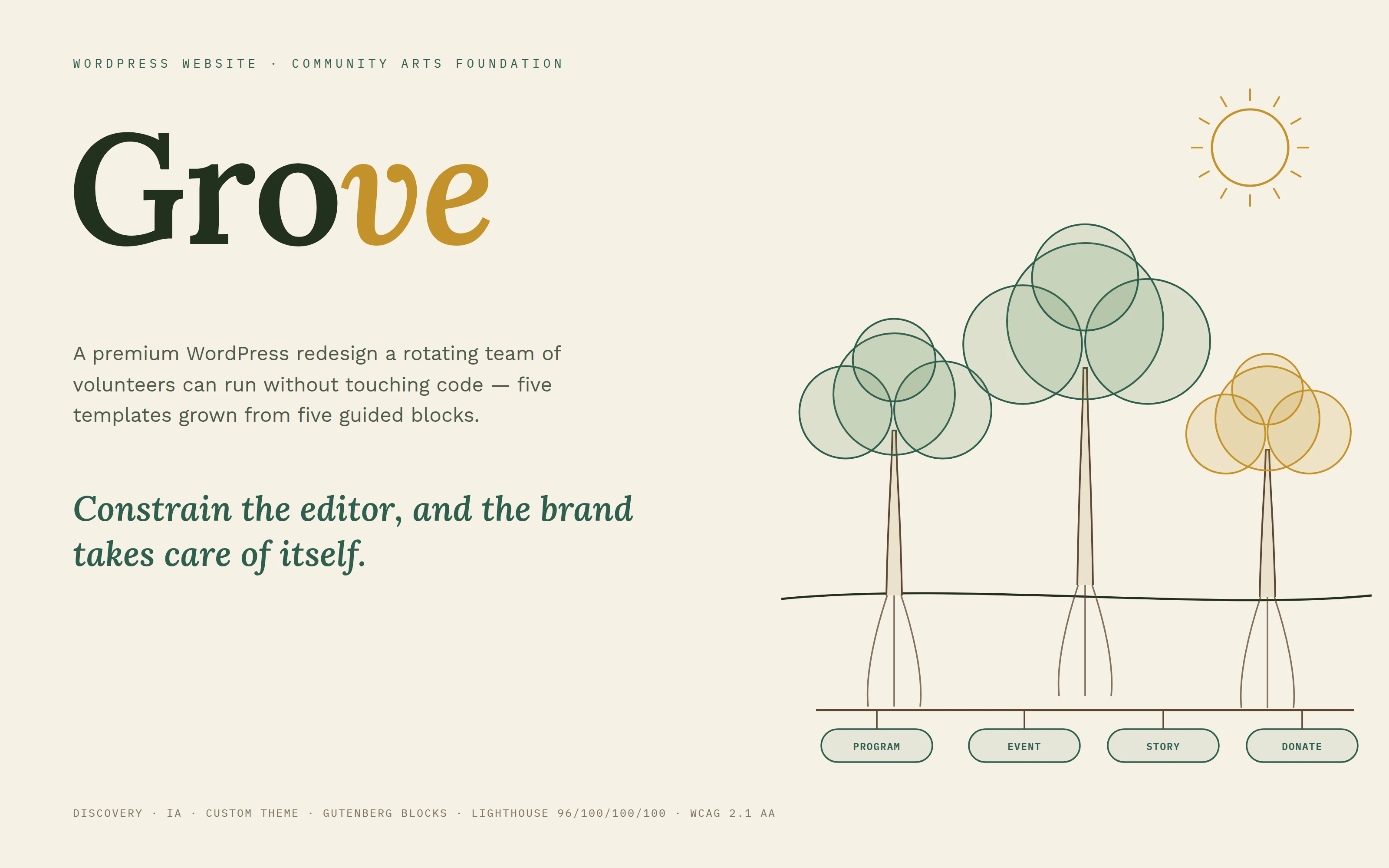
A premium WordPress redesign for a community arts foundation — a warm, current site its own volunteers can run without touching code.
Grove, a community arts foundation · WordPress website · 2026
Role
Designer & WordPress Build
Scope
Discovery, IA, custom theme, Gutenberg blocks, performance, accessibility
Outcome
Volunteers edit in guided blocks · Lighthouse 96/100/100/100 · WCAG 2.1 AA
The site is a grove — the IA, drawn
Blocks, sown like seed packets
From notice board to garden
Read the growth rings — Lighthouse
Saturday, 9:02 a.m. — the editor journey
Overview
Grove is a community arts foundation — free classes, exhibitions and micro-grants across a city. Its old site was a notice board of PDFs and dead links that only one staffer could update. I redesigned it on WordPress into a warm, current site the whole team can run.
The challenge
The people who keep a nonprofit’s site alive are rarely developers. Content changes weekly — new programmes, events, a donation push — and the old build broke every time someone tried. The brief: a site that looks bespoke but is edited in minutes, by volunteers, without breaking the design.
Why WordPress
WordPress was the right tool precisely because it isn’t glamorous — it’s the platform a rotating team already half-knows, with a plugin for every non-core need and a hosting bill a nonprofit can afford. The design bet: don’t hand editors a blank page builder. Give them a small set of custom blocks — Program Card, Event, Donation CTA — each with guided fields, so every edit stays on-brand.
Process
Discovery and a content audit came first — what actually gets updated, by whom, how often. That shaped an information architecture of five sections and a WordPress template hierarchy that maps cleanly to how content is created. Then a custom theme, ACF-powered blocks, and a plugin strategy chosen so staff never edit code.
The design system
A warm identity — forest green, cream, and a gold that signals ‘give’ — with a friendly serif for headings over a clean humanist sans. Everything an editor touches is a block with constrained options: image, title, schedule, one accent colour. The system is the guardrail; the brand can’t drift.
The final solution
Home, Programmes, Events, Donate and News — each a WordPress template, each composed from the same blocks. Editors work in Gutenberg with a right-hand panel of plain-language fields; donations run on GiveWP, events on The Events Calendar. It looks custom and updates like a document.
Results
Fast and open — a Lighthouse profile of 96 / 100 / 100 / 100, largest-contentful-paint down from 5.8s to 1.6s, page weight from 4.2MB to 0.9MB, and WCAG 2.1 AA baked into the blocks (semantic headings, enforced alt text, 4.5:1 contrast). The real result is organisational: the site stopped depending on one person.
Lessons learned
The best CMS work is invisible. The measure of this build isn’t the homepage — it’s whether a volunteer can add Saturday’s workshop in two minutes and trust it will look right. Constrain the editor, and the brand takes care of itself.
Next case study
Verdant →