Selected Work / Culture Shock: the campaign
Culture Shock: the campaign
Nine visual puns on belonging take an exhibition to the street.
Museum of the Diaspora (concept) · 2025–2026
Role
Creative Director, Designer & Illustrator
Scope
Icon system → exhibition identity → OOH campaign
Outcome
A launch campaign where every ad is the artwork itself
The brief: give the icons a job
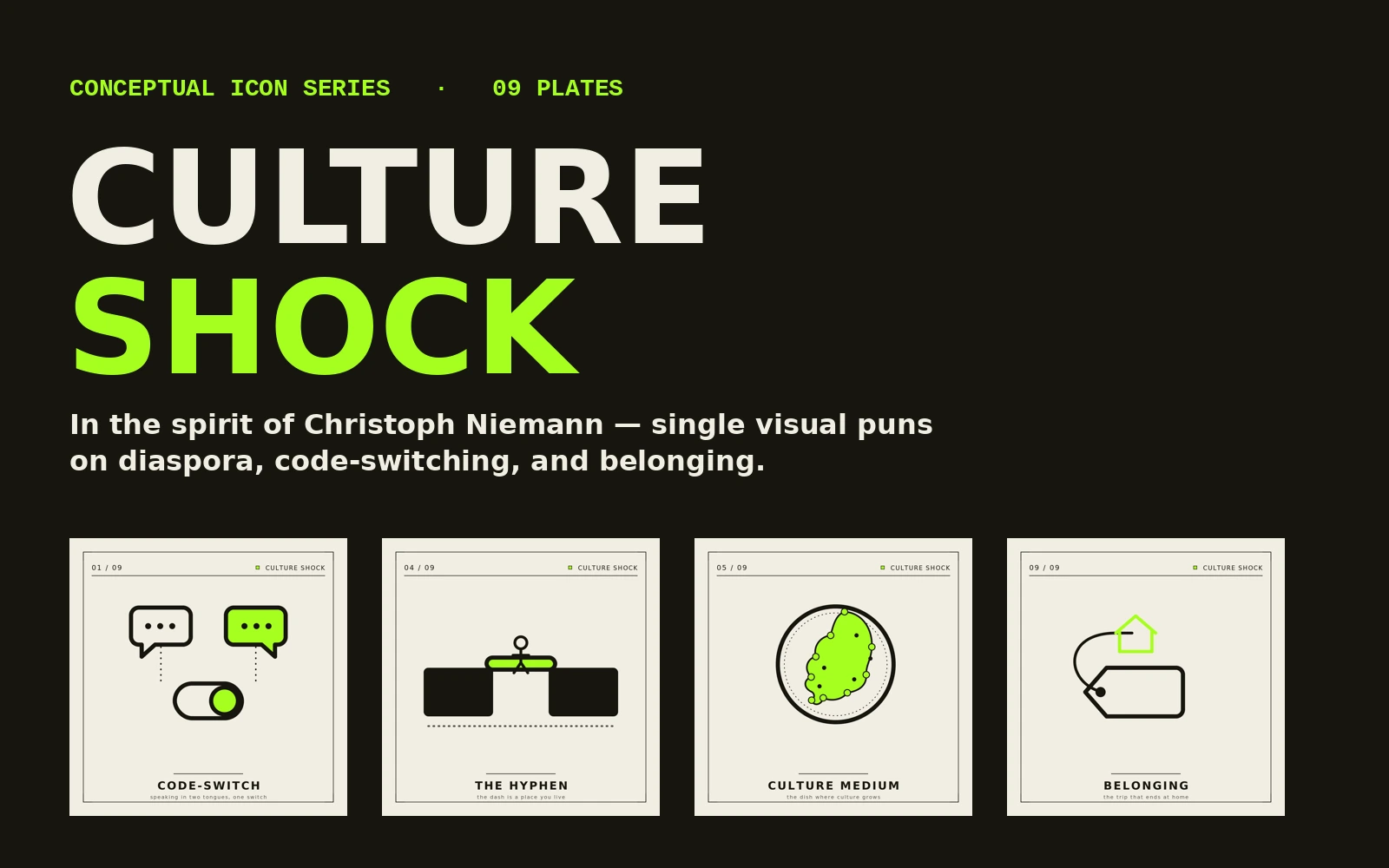
Culture Shock began as an icon series — nine visual puns on diaspora, code-switching, and belonging, in the spirit of Christoph Niemann. This campaign gives the system a purpose: the launch of Culture Shock — an exhibition on belonging at the Museum of the Diaspora, carrying wayfinding, dates, and a public promise.
The ad is the exhibit
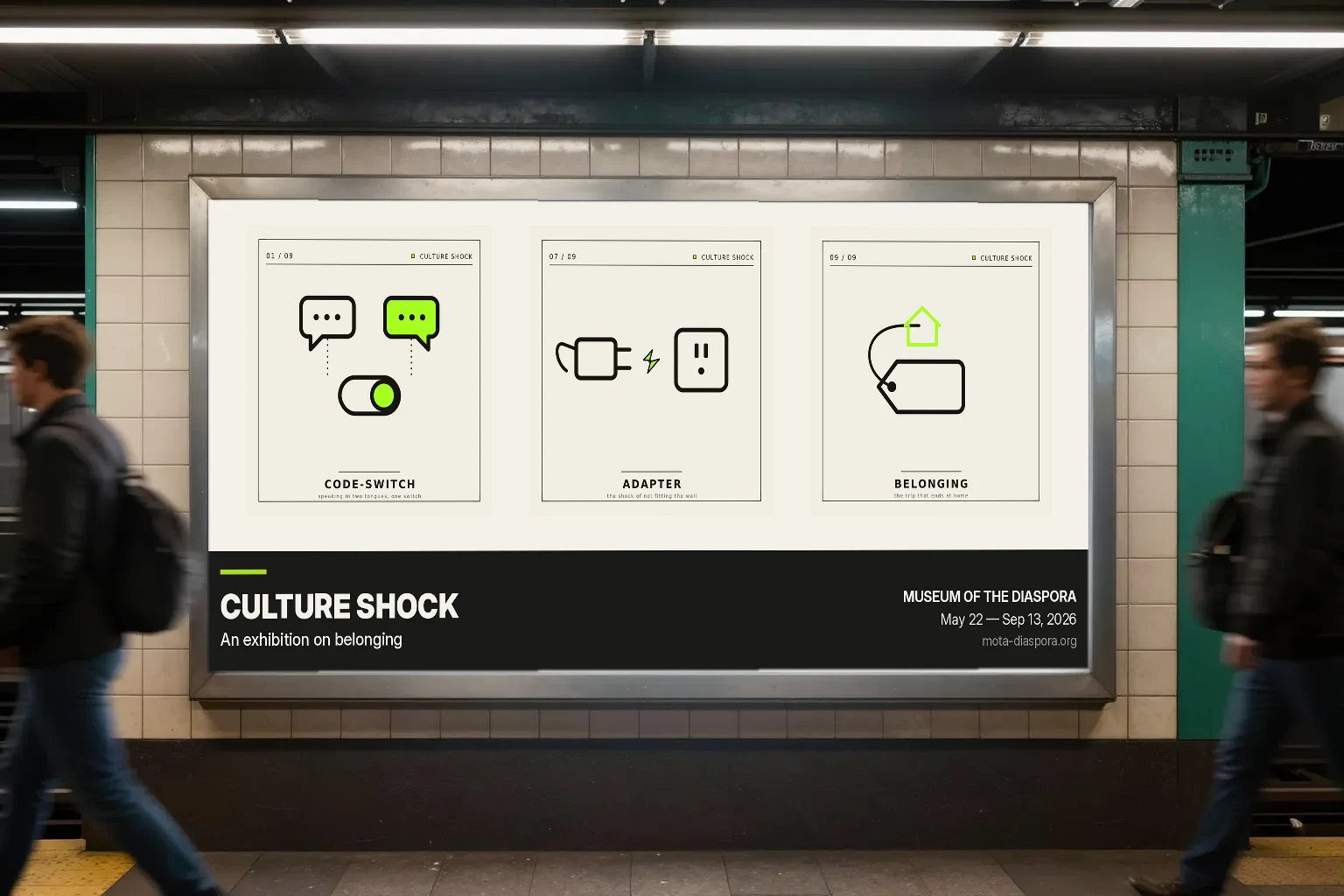
Most museum campaigns photograph the gallery. Here the artwork is an icon system — so the campaign can simply be the work. Every poster is a plate from the series, unchanged. If a commuter smiles at the pun, they’ve already experienced the exhibition once.
Strategy
Ship the plates untouched; let a single lockup band carry the institutional voice — title, dates, wayfinding. One fluorescent act of color per execution, ink-on-paper ground, no caption that explains the joke. The discipline that made the plates work at gallery size is the campaign’s art direction.
Plate → poster → street
Each execution shows the progression: the untouched plate, the poster with lockup and headline added, and the placement in situ — a subway platform running three plates together, a billboard leading with Adapter (‘New wall, same current.’), a backlit bus shelter for Belonging, and the museum facade banner bringing the system home.
Creative Direction
Held the constraint at forty feet: one fluorescent act per execution, no exceptions. Headlines borrow the plates’ own captions — the campaign never says anything the icons don’t already say.
Reduction scaled up
Nine concept plates became an exhibition identity, four OOH executions, and a lockup system — a personal series graduated into a campaign-grade identity with its authorship intact. Full progression in the case-study PDF.
Lessons learned
If an idea needs a caption, it isn’t reduced enough — and if it’s reduced enough, it scales from a square print to a subway platform without redrawing a line.
Next case study
Litigation, made legible →