Selected Work / 432 Days
432 Days
A concert hall, fourteen months late — forensic-schedule graphics for a fictional construction arbitration.
Independent speculative study · Speculative R&D · 2026
Role
Litigation designer & forensic-schedule visualizer
Scope
Schedule simplification, 11-exhibit demonstrative system, progressive builds
Outcome
A drawing-set visual language a panel can reason with
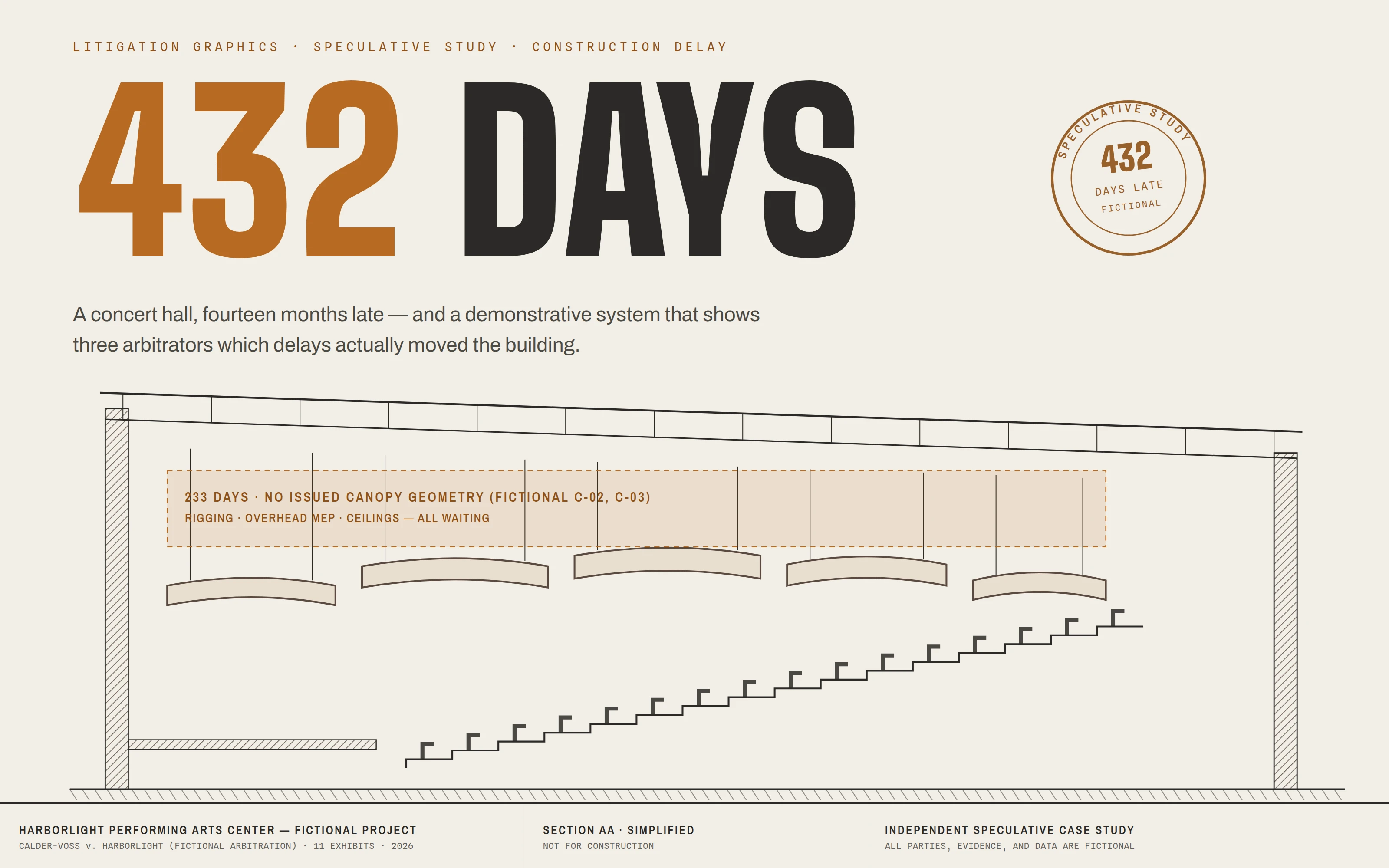
Planned vs. built — nine phases, 432 days
The canopy, in section
Two decisions, two chains
The contested window
432 days, two accountings
Challenge
Delay cases drown their own fact-finders. Everything overlaps: a storm, a donor-driven redesign, a façade re-procurement, a summer of ductwork rework, a switchgear order lost to a broken supply chain — all inside the same 432 late days, all claimed by opposing experts using different methods. The panel cannot allocate a single day until it can see the one thing no witness can gesture at: the critical path.
Opportunity
The building itself is the best teacher in the room. A concert hall is a legible sequence — you cannot hang a ceiling you haven’t drawn, or finish rooms in a building you haven’t enclosed. Draw the hall in section, shade what waited on the canopy, and dependency stops being scheduling jargon; it becomes architecture.
Strategy
Literacy before advocacy. First the nine-phase model of the project and the idea of the path; then the events, landing one at a time in calendar order where their logic puts them; then the contested eight-month window, with the opponent’s best evidence drawn at full size and the contemporaneous monthly record standing between the two stories; finally the 432 days allocated twice, once per expert, methods named, sums reconciling — including the 27 days our own side concedes, in our own color.
Process
Built the fictional project record first — baseline schedule, 34 monthly updates, RFI and change-order logs, procurement files, weather data — and locked every date and day count so all eleven exhibits reconcile to the same 432. Reduced the network to nine phases with a stated method, then designed the system outward from the two exhibits the case would be won or lost on.
Creative Direction
A drawing-set aesthetic: plaster paper, charcoal linework, drafting labels, dimension strings, a title block on every panel. Three semantic inks — ochre for owner decisions, steel blue for contractor work, moss for the world’s delays — and an unbudging rule that disputed time is hatched, never quietly assigned.
Outcome
As a speculative system, the study demonstrates the full delay-case toolkit: schedule simplification with a defensible method, concurrency handled honestly, competing expert models displayed at equal weight, and a progressive build that lets a panel watch control of the completion date move through the project. The deliverable is the communication system; no award or result is claimed.
Lessons learned
In a delay case, credibility is spent in exactly one place: how you treat the days that could belong to either side. Hatch them, cite the monthly record, and the exhibit that concedes the most is the one the panel trusts to answer the question.
Disclosure
Independent speculative case study. All parties, evidence, and data are fictional and were created solely to demonstrate litigation-graphics strategy.
Next case study
The Fortune 1000 stage →