Selected Work / 3.8 Seconds
3.8 Seconds
A left turn across a lane the driver could not see — 3D collision reconstruction for a fictional jury trial.
Independent speculative study · Speculative R&D · 2026
Role
Litigation designer & 3D reconstruction visualizer
Scope
Kinematic model, procedural 3D scene, 9-exhibit demonstrative system, sightline and avoidability analysis
Outcome
One model the jury can trust — and an honest answer to the speed question
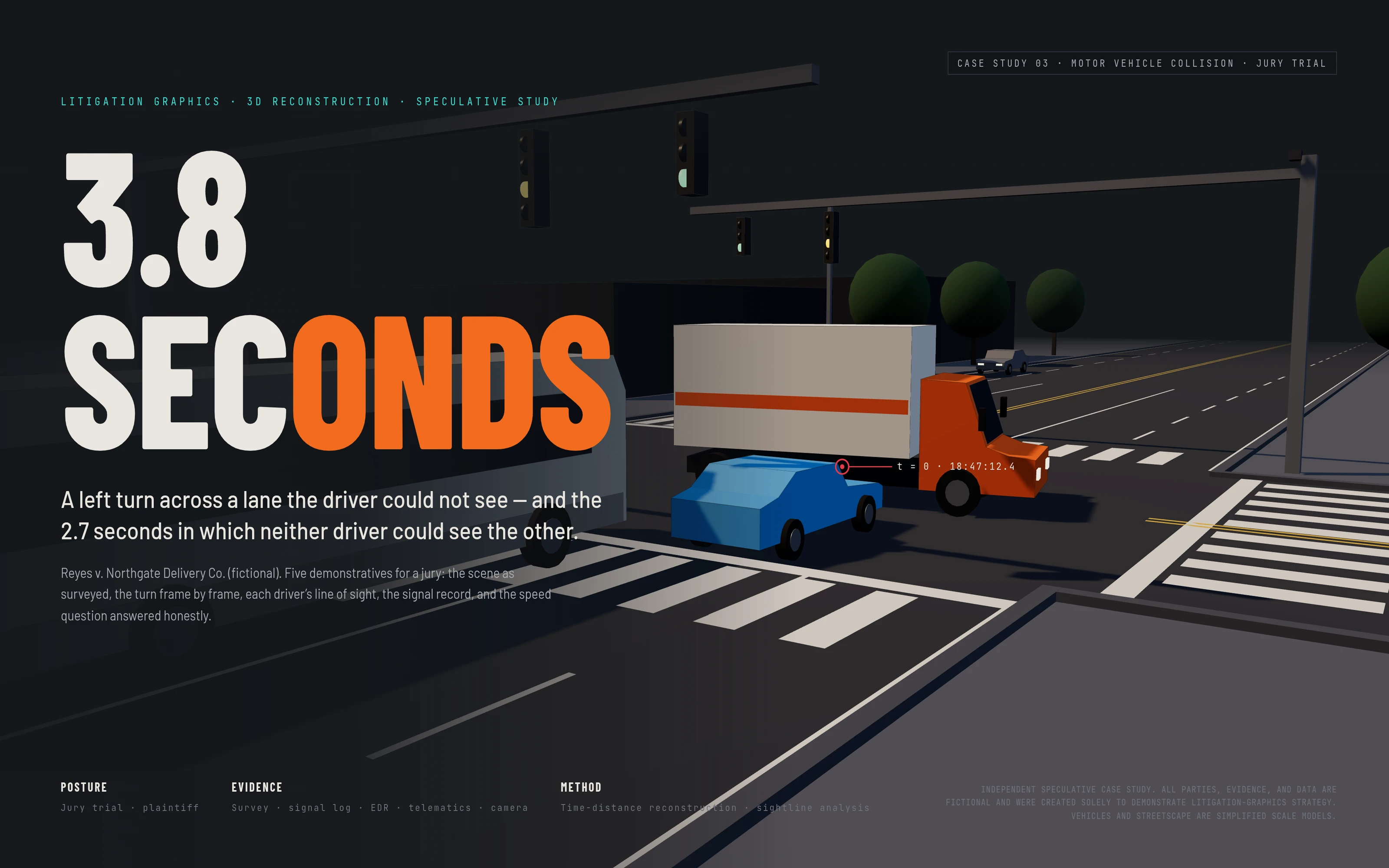
The scene, as surveyed — 3.8 seconds before impact
The turn, frame by frame
Lines of sight — you cannot yield to what you cannot see
The signal — testimony v. record
The speed question — avoidability at five speeds
Challenge
A left-turn collision at dusk: a delivery truck crossing the northbound lanes on a flashing yellow arrow, a sedan doing 41 in a 35, and a transit bus stopped between them in the opposite turn pocket. Each side has a story the jury can picture without help — “he ran the turn” versus “she was speeding” — and five data sources that nobody on the panel can read: a survey, a signal-controller log, a city camera frame, an event data recorder and fleet telematics. Fault turns on 3.8 seconds no witness saw whole.
Opportunity
Every one of those sources describes the same world in the same units. Reconcile them into a single kinematic model, build the intersection to survey, and the jury no longer has to choose between two memories; it can watch the record. The signature exhibit is a driver’s-eye render from the truck’s seat, computed rather than imagined, showing that the bus hid 97 metres of the very lane the driver was turning across.
Strategy
Establish before you argue. First the scene as surveyed, every party labelled and sourced; then the turn frame by frame from one fixed camera, every position generated from data; then the sightlines, the moment the case turns on; then testimony set beside the controller log and the camera timestamp; and last the speed question answered before the defense can ask it — at the posted limit the collision still happens, at 25 mph instead of 35, and the defense’s 52 mph is ruled out by the crush evidence.
Process
Built the fictional record first — survey, signal timing sheet, controller log, EDR trace, telematics, camera frame, deposition lines — then wrote a physics model that reconciles them and locked it. Modelled the intersection and three vehicles procedurally in three.js so every camera is a surveyed position and every frame is a state of the same model; rendered the five panels, the cover and the print set from that one scene.
Creative Direction
Night-road palette: charcoal asphalt, warm low sun, four semantic colours — truck orange, sedan blue, bus grey for the party that is not a party, and teal for anything the analysis adds to the world. Vehicles are deliberately simplified scale boxes so nothing reads as a photograph. Condensed display type, a monospaced evidence layer, and a title block with sources and the fictional-matter notice on every panel.
Outcome
As a speculative system, the study demonstrates the full collision-case toolkit: data reconciliation with a stated method, computed sightlines a jury can stand inside, testimony placed against the record without editorialising, and an avoidability analysis that concedes what must be conceded. The deliverable is the communication system; no verdict or result is claimed.
Lessons learned
In a collision case the exhibit that survives cross-examination is the one that would have looked the same if the other side had built it. Fix every position to a source, show the speeds you would rather not, and the jury will trust the one number that matters.
Disclosure
Independent speculative case study. All parties, evidence, and data are fictional and were created solely to demonstrate litigation-graphics strategy.
Next case study
The Fortune 1000 stage →