Studio NotesArt History
Van Gogh Ran Out of Canvas, So He Grabbed the Dish Towel
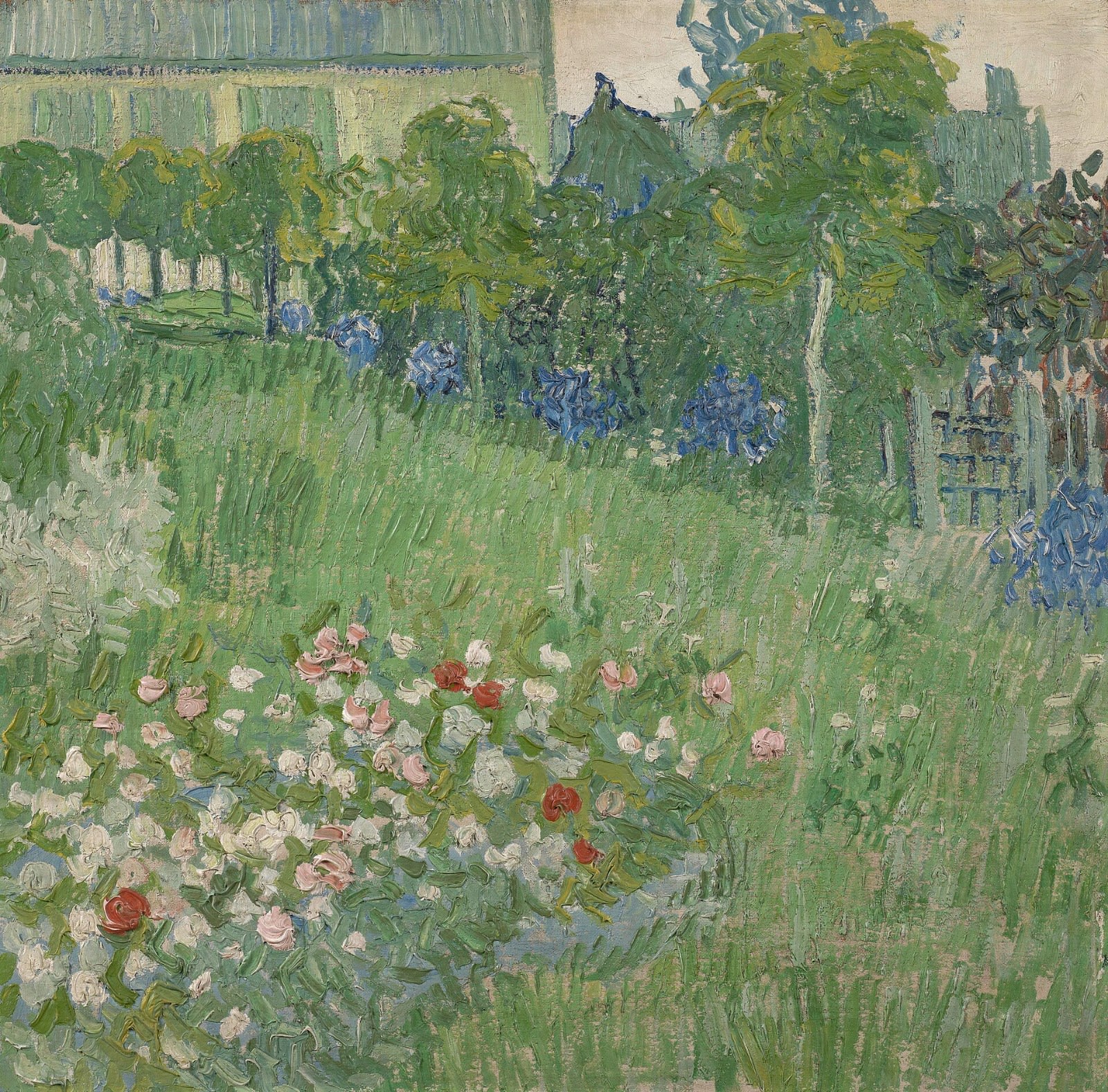
Flip over Van Gogh's Daubigny's Garden and you find red stripes: he painted it on a kitchen towel. Then the towel got stranded in America for the whole of the Second World War.

· 3 min read
Anyone who paints knows the moment. The idea is right there, the light is right there, and the good canvas is… not there. So your eyes start roaming the room for anything flat. A cardboard box. A cabinet door. The back of last month's mistake.
In June 1890, in a village inn outside Paris, Vincent van Gogh's eyes landed on a kitchen towel.
What happened
Today, Van Gogh specialist Martin Bailey used his weekly column in The Art Newspaper to do something museums rarely let us do: turn a painting around. The picture is Daubigny's Garden (June 1890), a small, almost square view of the garden of Charles-François Daubigny, the landscape painter Vincent admired, in Auvers-sur-Oise.
On the back, near the top and bottom edges, run two red stripes woven into the fabric. That's not artist's canvas. It's a torchon — a French striped tea towel.
The Van Gogh Museum's own catalogue entry confirms it: with no canvas at hand, he painted on a red-and-white striped tea towel, after first coating it with a bright pink ground of lead white mixed with red. Bailey thinks the towel most likely came from the kitchen of the Auberge Ravoux, where Vincent was lodging. (That's an educated guess, not a receipt. Nobody kept the laundry list.)
The pink that turned grey
Here's the detail worth sitting with. That pink layer was meant to show between the strokes, so hot pink would buzz against all that green. But the museum notes the red pigment has faded, and the pink now looks grey.
So the painting we see is quieter than the one he made. A question worth asking (interpretation, not fact): how many "subtle, soft" 19th-century pictures are actually loud ones that lost their voice?
The towel that couldn't go home
The back of the stretcher is covered in small exhibition labels, the kind museums stuck on freely in the mid-20th century. According to Bailey, the painting has been lent to 105 exhibitions since 1896, and the labels record 17 of them.
The labels skip one detour. In 1938–39, the artist's nephew, V.W. van Gogh, sent Daubigny's Garden and 13 other Van Goghs to shows in Batavia (now Jakarta), Surabaya and Bandung, in what was then the Dutch East Indies. From there the paintings went directly to San Francisco, for the Masterworks of Five Centuries display at the Golden Gate International Exposition, which opened on 18 February 1939.
Then history got in the way. War broke out in Europe in September, the San Francisco show closed on 29 October 1939, and sending the paintings back across the Atlantic was too risky. So the 14 pictures were quickly turned into a touring show: Toledo, Montreal, Syracuse, the Museum of Modern Art in New York. Bailey counts 39 North American cities between 1939 and 1945.
Picture it: a dish towel from a village inn spent the Second World War as a cultural ambassador, crisscrossing a continent while its home country was occupied. Not bad for something meant to dry plates.
Why care
Materials tell the truth. On 17 June 1890, Vincent wrote to Theo that he had finished "a small study" of Daubigny's garden, and that it gave him the idea for "a more important canvas." Once Theo sent canvas, he painted two big double-square versions, now at the Hiroshima Museum of Art and in the Rudolf Staechelin collection in Switzerland. The towel was the sketchbook. The canvas was the commitment. There's a reason sketchbooks exist: the surface that "doesn't count" tends to get the freer marks.
The back of a painting is its passport. Stamps, stickers, scribbles: that's where a picture's travel history lives. Bailey notes those labels are much less common now, which makes you wonder what future historians will flip over and find. A barcode?
Scarcity is a style. Running out of supplies forces a decision, and sometimes that decision becomes the work. (Even his paper did double duty: a two-sided Auvers sketch, still life on the front and a walking couple on the back, sold at Christie's Paris on 23 October for €230,400.)
So, a question for the coffee table: if someone flipped over your favorite piece of art, what do you think they'd find on the back, and would you want them to look?
Sources
- The Art Newspaper — Behind a Van Gogh picture: the stories revealed on the reverse (Martin Bailey, 30 Oct 2026)
- Van Gogh Museum — Daubigny's Garden (s0104V1962), collection entry
- Vincent van Gogh: The Letters — Letter 889, to Theo van Gogh, Auvers-sur-Oise, 17 June 1890
- Wikimedia Commons — De tuin van Daubigny (s0104V1962), public-domain reproduction
- Vincent van Gogh
- Daubigny's Garden
- Van Gogh Museum
- Auvers-sur-Oise
- Painting materials
- Provenance
- Second World War