Studio NotesExhibitions
The Woman Holding the Flowers Finally Gets the Painting
For 160 years, everyone looked at Olympia. Chris Ofili just painted the woman standing next to her — and gave her back her name. A new show in Turin asks who gets to be the subject.

· 3 min read
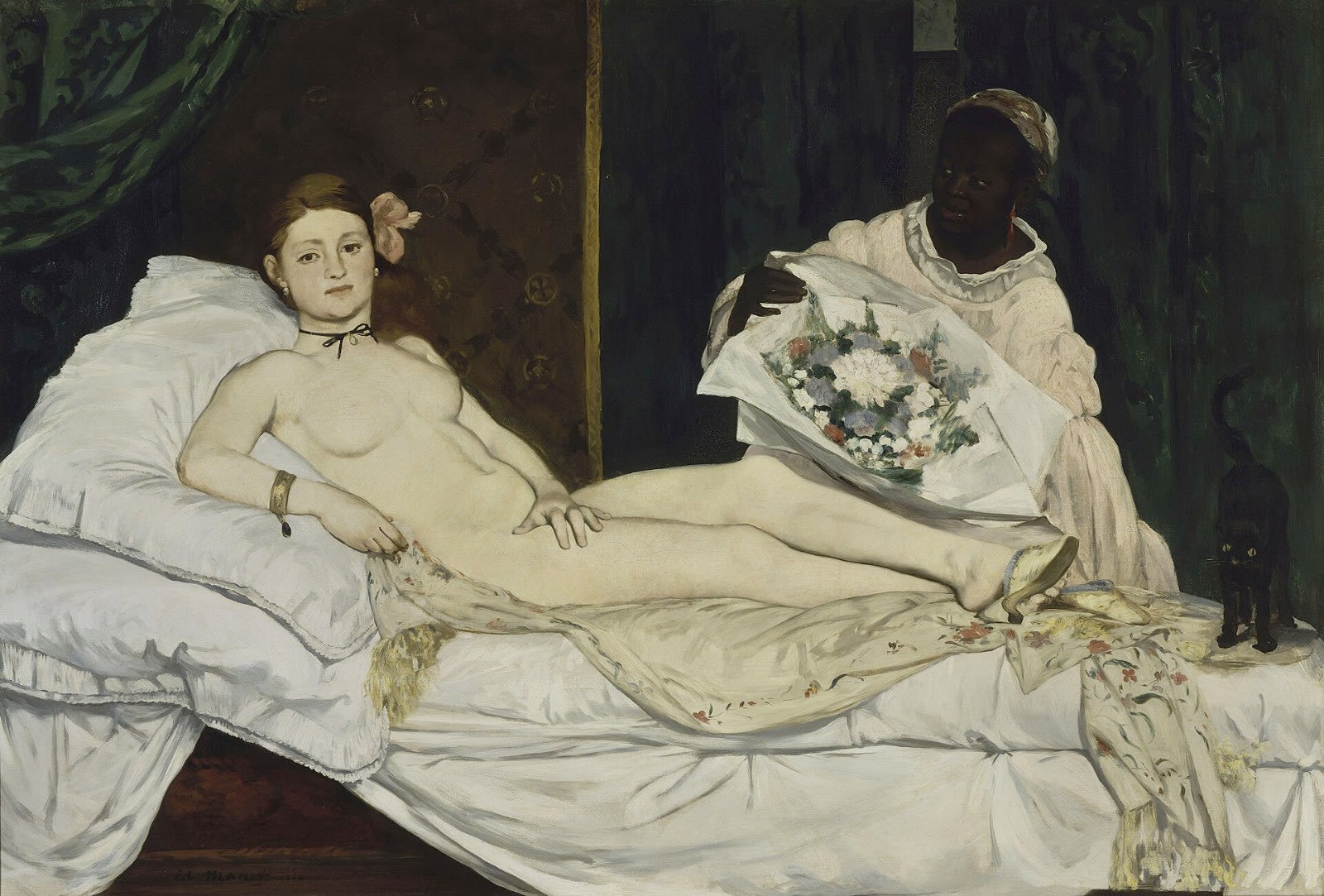
Quick test. Picture Manet's Olympia. Go on, I'll wait.
You pictured the woman on the bed, right? The pale one with the ribbon around her neck, staring at you like you owe her money. Of course you did. That's who the painting — and about 160 years of art history lectures — told you to look at. But there's another woman in that picture, standing up, doing the actual work, holding a bouquet the size of a toddler. Her name was Laure. And as of today, she has her own exhibition.
What happened
Laure. Chris Ofili & Édouard Manet opens today at the Pinacoteca Agnelli in Turin and runs through April 4, 2027. The setup is beautifully simple: the museum owns a small Manet, Portrait of Laure (around 1862), and invited Chris Ofili to answer it.
For a long time that portrait's title was a racial label, not a name. The museum now calls it Portrait of Laure, because research into Manet's own papers identified the sitter as a woman who lived near his Paris studio. And by "research," I mean an actual line in Manet's notebook, now at the Morgan Library, recording Laure's name and her address on the rue de Vintimille — third floor. That's it. That's most of what survives. One line of handwriting, and two paintings.
Ofili's response is a new large painting, Saint Laure (2026), made the same size as Olympia, plus a watercolor and drawings. According to The Art Newspaper, he turns Olympia's reclining body into a desert landscape along the bottom of the canvas, and builds Laure from angels in Italian painting — think Giotto, Fra Angelico — and from the "woman in the desert" in Matteo Garrone's 2023 film Io Capitano. In the museum's framing, Laure becomes a guide for people migrating — "the guardian of others."
Curator Pietro Rigolo put the idea plainly to The Art Newspaper: Ofili starts from "giving back to this woman her name and her identity." Also from Rigolo: nobody has objected to the renaming. Which, honestly, is the least surprising sentence in art journalism this year.
Why it's worth your coffee
None of this came out of nowhere. Curator Denise Murrell built a whole field of looking around Laure — her research became Posing Modernity in New York in 2018 and then the Musée d'Orsay's 2019 show on Black models, where several paintings were temporarily retitled after their sitters. Murrell contributes to the Turin booklet, too. So the scholarship has been knocking for years. What's new is an artist of Ofili's weight walking through the door with a brush.
And here's the observation I can't shake: Manet painted Laure as an accessory to someone else's story — she's literally delivering flowers from an offstage admirer. Ofili flips it so the reclining nude becomes the landscape, the background, the ground you walk across. Same size canvas, same two women, entirely different idea of who matters. It's not erasing Manet. It's re-hanging the spotlight.
A few questions to chew on:
- If the only written trace of you was your address and one adjective, how would you want to be painted?
- Why does making a painting exactly the same size as a famous one feel like such a power move? (Is it a reply, or a rematch?)
- Olympia stares out at the viewer. Laure looks at Olympia. In a room full of people looking at the "main character," what does it mean to paint the one who's looking somewhere else?
- How many "anonymous" figures in your favorite paintings had a name somebody just didn't bother to write down?
Full disclosure, there's a studio connection here: my own Caribbean Venus series started from a cubist Birth of Venus I painted in 2007 and carried her home into Caribbean light — conch shells for scallops. Answering a masterpiece instead of just admiring it is one of the oldest moves in painting. Ofili's version just comes with a much sharper question attached.
The bigger picture
Museums love saying they're "rethinking the collection." Usually that means a new wall label. Turin did something more interesting: it handed one small painting to a living artist and let him argue with it for five months in public. Imagine if every museum picked one overlooked figure in its permanent collection each year and commissioned a reply.
So here's my question for you: which background character in art history do you think deserves her own show next — and what would you hang next to her?
From the studio
Caribbean Venus — re-painting a master, carried home →Sources
- The Art Newspaper — Chris Ofili brings story of Laure in from the margins at Turin exhibition (Gareth Harris, 30 Oct 2026)
- Pinacoteca Agnelli — exhibition announcement via e-flux (Laure. Chris Ofili & Édouard Manet, 30 Oct 2026 – 4 Apr 2027)
- Pinacoteca Agnelli, Turin — official site
- The Morgan Library & Museum — Édouard Manet's Notebook, 1860–62 (the Laure entry)
- Hyperallergic — Musée d'Orsay puts focus on overlooked Black models (2019)
- Chris Ofili
- Édouard Manet
- Olympia
- Laure
- Pinacoteca Agnelli
- Turin
- Art history
- Black models in art