Selected Work / Telar: the loom that holds the world
Telar: the loom that holds the world
Ancestral Andean iconography, repainted for the modern conversation on equality.
Advertising campaign · 2026
Role
Creative Director & Artist
Scope
Concept system, art direction & oil painting series
Outcome
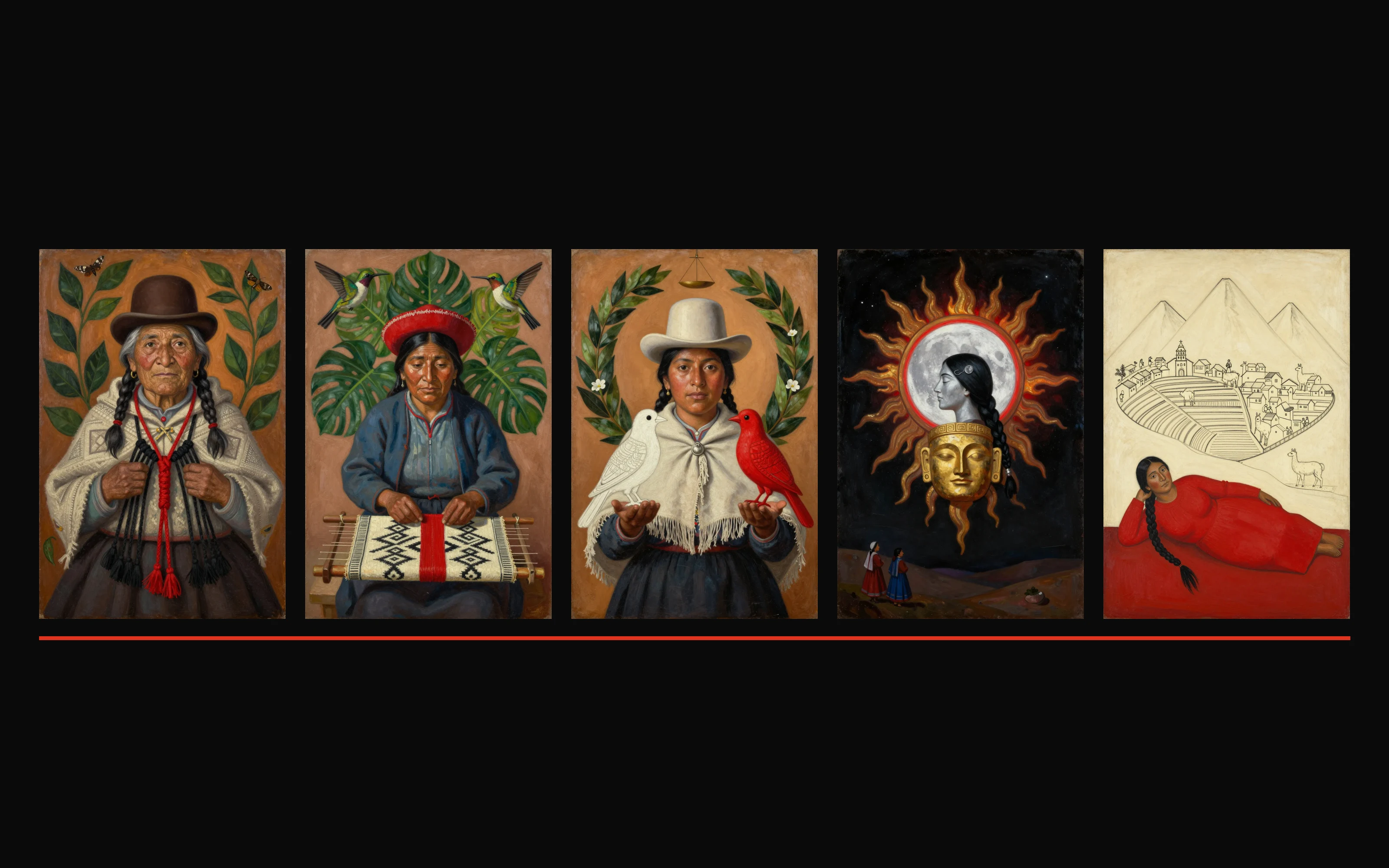
A pointed nine-painting series with a clear point of view
Challenge
Equality, feminism, and patriarchal power are the loudest conversations in culture — and the most flattened. Most visual work on the subject defaults to protest-poster volume, which audiences tune out. The challenge was to say something sharp about these systems in a register that's intelligent and disarming rather than declarative, while honoring living Andean symbolism instead of mining it for decoration.
Opportunity
I already had the Andean Icons series — a vocabulary of ancestral motifs (the khipu, the chakana, the loom, Pachamama). Reframed, that vocabulary becomes a precise instrument for talking about labor, hierarchy, and voice. The opportunity was to translate folklore into a reductive conceptual language — one motif, one idea, one mark — so each piece lands in a second and keeps working after.
Strategy
Build the system first, then give it flesh. The grammar stays locked — one Andean motif, one modern idea, one vermillion act per piece — but the execution is oil paint: frontal folk-surrealist portraiture in the lineage of Frida Kahlo and the retablo tradition, where symbols do the arguing. Restraint survives the translation: however lush the canvas, the red is only allowed to fall in one place — the woman, the rupture, the voice.
Process
Researched the original meaning of each Andean motif, then paired it with a modern idea until the two fused into one image — the knotted khipu as the record of women's uncounted labor, the symmetrical chakana as the pay gap drawn in geometry, the loom's one red thread that holds the whole cloth. Reduced each concept to its single sharpest move as a study, then painted it: nine vertical oil portraits — earthy folk palettes, symbolic flora and fauna, and exactly one vermillion element carrying the argument on every canvas.
Creative Direction
Owned the constraint across a riskier medium. In ink, one red mark is easy discipline; in full-colour oil it has to be composed — every palette built so the single vermillion act reads as the loudest thing on the canvas without shouting. Captions stay mono, one line, no explanation — the viewer does the last step of the thinking. The discipline is the authorship: nine paintings that are unmistakably one argument.
Outcome
A coherent nine-painting series with a clear point of view and a reusable visual grammar — exhibition-ready as a 3×3 grid, print-ready as a vertical drop, and legible as a designed system rather than a mood. Proof that concept-led Creative Direction survives the jump from icon to canvas.
Lessons learned
A whisper with a clear idea behind it carries further than a shout. The more I reduced each piece, the more it said — even once the paint got loud.
Next case study
Unraveled Identities →